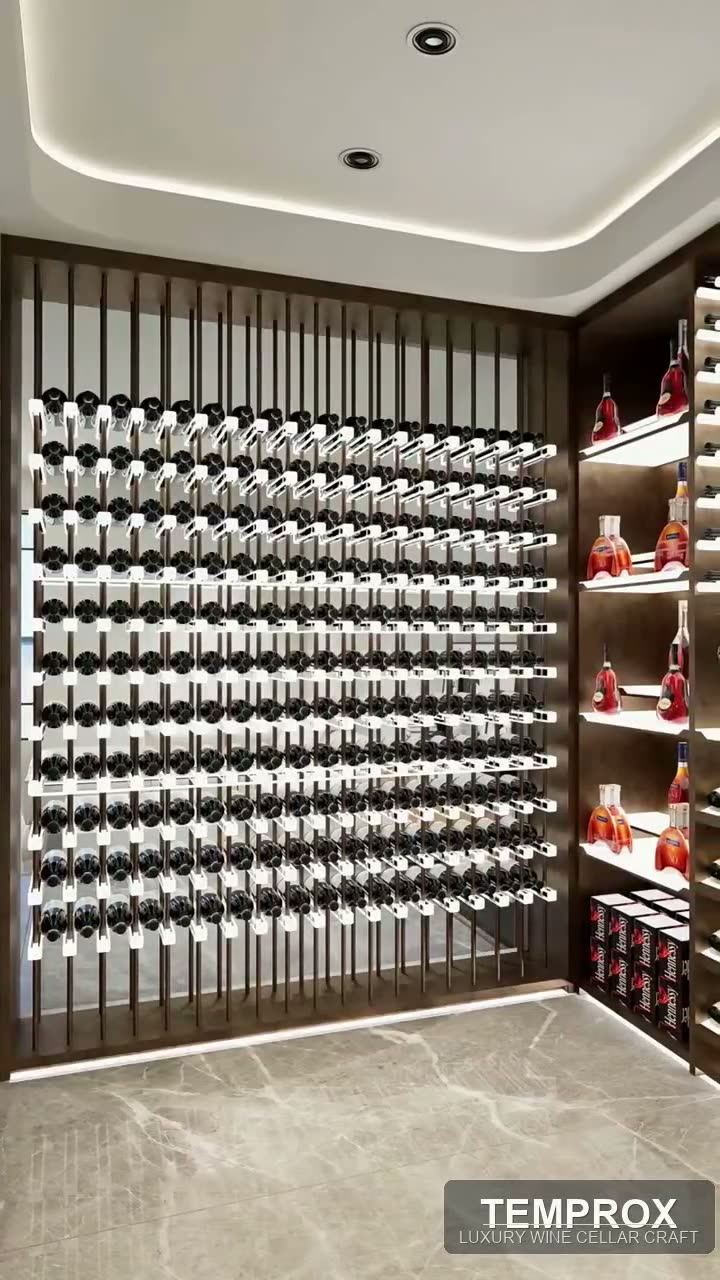
Two commissioning engineers got tired of signing off wine cellars that nobody could prove worked. So they started writing the proof themselves.
Frankfurt, 2008. A hotel refit, three weeks behind. The cellar had been installed by a contractor who had already left site. At handover there was no pressure-test record, no weld map, no condensate calculation — only a verbal assurance that it had been 'checked'.
One of the two engineers on that job carried a red non-conformance pad. He wrote four words on it that later became the first clause of this company: NO RECORD — NO ACCEPTANCE.
They registered Temprox the following year with a single promise: every unit arrives with the paperwork that proves it works before anyone is asked to believe it.
Treat a wine cellar as furniture and it will fail in the second summer. Treat it as a mechanical and electrical package and it behaves. Thermal break in every frame. Condensate designed before it forms. Door pressure calculated against the room volume, not guessed from the gasket catalogue.
Every Temprox shipment carries four documents: the submittal drawing set, the weld map, the pressure-decay log and the O&M manual. Facilities teams keep them; that is the point.
Restaurant cellars are not photographed from the guest side; they are serviced from the back. Six hundred millimetres of working clearance. Lift-off plinths. Filter access without tools. Hinges rated to 500,000 cycles because a service door in a hotel is opened forty times a night, not four.
Our bar counters are drawn around the bartender's route — ice, glass, pour, return — because a beautiful counter that slows service is a failed drawing.
EN 1090 structural compliance, EN 60335 appliance safety, HACCP-compatible contact surfaces, laminated anti-bandit glazing where stock value demands it. These are the minimum. The ceiling is a unit that a third-party commissioning agent cannot find fault with.
We have been audited by other people's engineers for seventeen years. It made us boring in exactly the right way.